


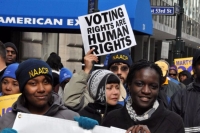
What would those who marched for equal rights for Blacks say today if they heard the reasons why people choose not to vote? “I forgot to register” “My vote doesn’t make a difference?” “Politicians just lie, so what’s the point?”
Congress passed the Fifteenth Amendment in 1869, giving Black men the right to vote. Women would not be given the right to vote until 1920, fifty-one years later. Given the struggles that African Americans have traversed throughout history, it’s no wonder that many from the generations born before generation X do not understand why younger generations don’t see the importance of voting.
Chicagoan Dennis Woods, 58, reflected on the Ferguson, MO protests that were ignited from the August 2014 death of Michael Brown, an unarmed Black male. When asked why more African Americans need to take voting serious, he responded with:
“One word…Ferguson. All of those young people who are willing to cast bricks at police and store front windows need to redirect their energy to casting a vote in the ballot box. We have more power than we think we do. If that wasn’t the case, why are right-wingers concentrating so much effort and dollars into what amounts to voter suppression, if in fact, voting doesn’t make a difference? Clearly, they never want another President Barack Obama to happen again,” he said.
Even though the Voters Right Act was signed into law in 1965 to prevent voter suppression, it clearly exist. Sadly, voter ID laws disguised as voter process improvement disproportionately targets minorities, those of low-income backgrounds and young voters. States across the country, from Kansas to Florida to Wisconsin have had Republican lawmakers pass a variety of strict laws, like cutting down on early voting, placing restrictions on those who can help people vote and of course, new requirements for voter identification.
Illinois has yet to experience these types of laws and House Speaker Mike Madigan (D-Chicago) wants to make sure it never happens. The House passed a measure, 109-5, earlier this year to amend the Illinois Constitution. This would protect voters’ rights so they won’t be restricted like those in states that have already passed discriminatory voter ID laws.
The question that those who choose not to hit the polls need to ask themselves is what’s at stake if they don’t vote? What does it really mean if they don’t bother to cast their ballot on Nov. 4th? Black voters in particular have to vote to stay in the game. You do not get the right to voice your position, concerns, or issues if you’re not in the game.
“This is a battle for the soul of Illinois,” said Valerie Leonard, co-founder of a Chicago nonprofit, The Lawndale Alliance.
“Voting makes a difference, and the direction of this state is at stake, it will be impacted by who wins,” she said.
Note that Blacks in Chicago have always been a powerful force since their arrival here in large numbers. That force was revered when Harold Washington became the city’s first black mayor. And since then the Blacks of Chicago have seen the reorganization, re-gentrification of the City that Works that no longer worked the way whites in power wanted it to work.
At an endorsement luncheon for Gov. Pat Quinn, Rep. Robin Kelly (D-IL2) told The Chicago Defender: “People died so that we would have the right to vote and what I like to say, if you’re not at the table or a voice at the table then you’re on the menu so if we want to make changes, we have to vote.”
Early voting has already begun and voters are being asked a mix of binding and non-binding referenda questions. The proposed right-to-vote amendment is on the ballot. This will prevent the General Assembly from passing any voter ID laws that would discriminate a person’s right to vote. If passed, this amendment would be added to the Illinois Constitution:
“No person shall be denied the right to register to vote or to cast a ballot in an election based on race, color, ethnicity, status as a member of a language minority, national origin, religion, sex, sexual orientation, or income.” We might be reminded that our imprisoned are also ‘persons’ and note the Republican movement to deny them the right to vote.
Over the last few weeks, there have been dozens of ads with the goal of swaying voters to vote for one candidate over another. Some say that campaigning has not been this competitive in years. Candidates for governor and U.S. senator have been closely watched. Gov. Pat Quinn is running against Republican candidate Bruce Rauner and Sen. Dick Durbin challenges Jim Oberweis, the ice cream mogul.
The hot button issues that these candidates have hashed out in debates and campaign events revolve around education, whether or not assault weapons should be banned and if the minimum wage should be increased to $10 an hour. Voters will also get to vote on the minimum wage.
If you’re registered go to your polling place and Vote for you; vote for the candidates that best serve your interests. Make a difference.
Link to original article from The Chicago Defender
 Imagine going to the polls on Election Day and discovering that your ballot could be collected and reviewed by the
 ACLU Blueprints Offer Vision to Cut US Incarceration Rate in Half by Prioritizing 'People Over Prisons'
  "These disasters drag into the light exactly who is already being thrown away," notes Naomi Klein
  How about some good news? Kansas Democratic Representative advances bill for Native Peoples.
  What mattered was that he showed up — that he put himself in front of the people whose opinions on
 On a night of Democratic victories, one of the most significant wins came in Virginia, where the party held onto
 A seismic political battle that could send shockwaves all the way to the White House was launched last week in
 In an interview with Reuters conducted a month after he took office, Donald Trump asserted that the U.S. had “fallen
 Attorney General Jeff Sessions overturned the sweeping criminal charging policy of former attorney general Eric H. Holder Jr. and directed