

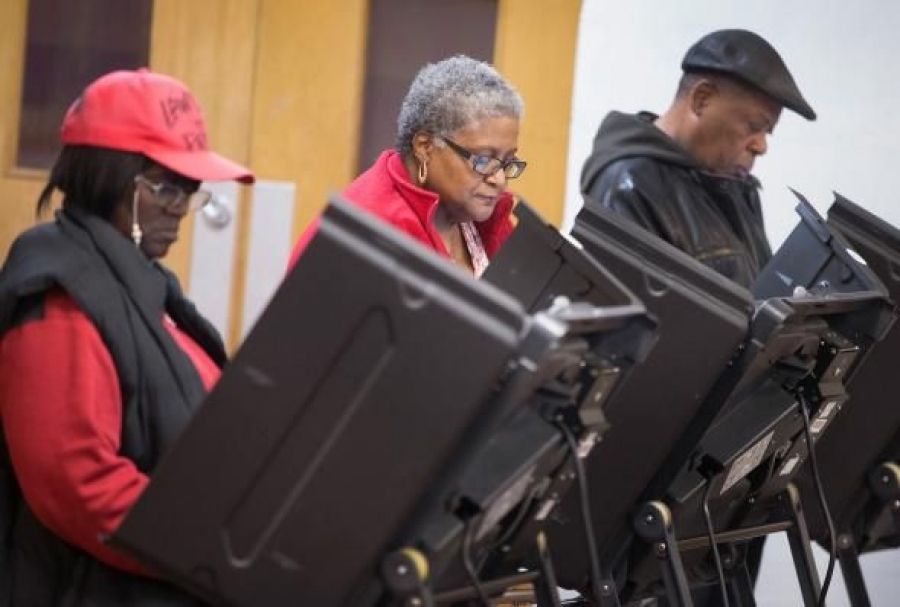
In Georgia, reports Zachary Roth for MSNBC, Republicans are pushing a bill to slash early voting from the present maximum of 21 days to 12 days. The goal, says Rep. Ed Rydners, a sponsor of the proposal, is “clarity and uniformity.” “There were complaints of some voters having more opportunities than others,” he said, “This legislation offers equal access statewide.” If cities like Atlanta want to have more voting access, said Rydners, they could open more precincts and “pay to have poll workers present.”
In Missouri, this new push comes as a constitutional amendment overturning a 2006 ruling from the state Supreme Court, which struck down voter ID as illegal under the state’s Constitution. Last Wednesday, notes Roth, the state’s House of Representatives gave “initial approval” to two measures: “One would put a constitutional amendment on the ballot asking voters to allow voter ID, and the other would implement the ID requirement, should the amendment pass.” The rationale? Voter fraud. “It’s not disenfranchising voters,” says state Sen. Will Kraus, who sponsored the amendment. “Voters who vote multiple times are diluting their vote.”
In New Hampshire, according to a recent report from the Brennan Center for Justice, Republicans are aiming for a hat trick of voter restrictions. If signed into law, their bills would limit voter registration efforts and reduce other registration opportunities, make it harder for students to register and vote, and reduce the number of precincts open per voter, a move that would lengthen voting lines and make the process a greater chore for working people and others with difficult schedules.
Likewise, per the Brennan Center, Mississippi Republicans are pursuing a bill that would “decrease the likelihood that otherwise-eligible voters who cast provisional ballots will have their votes counted in the races for which they are eligible,” and in Indiana, lawmakers have introduced measures to end automated straight-ticket voting and “secure” absentee ballots by requiring a voter identification number. “I just think people need to take the time to learn about who they are voting for before going in rather than just pushing a button for straight party,” said Rep. Milo Smith, chair of the Indiana House Elections Committee. “I think that makes for a better election process.”
It’s always worth noting the scant evidence for these moves. In Missouri, for instance, the Brennan Center found only four cases of in-person voter fraud, for a “documented fraud rate” of 0.0003 percent. There is no problem to solve; the policy rationale for limiting registration drives or requiring photo identification—instead of a standard-issue registration card—doesn’t exist. And if it did, there’s no reason for a restrictive approach; automatic registration and free ID cards are just as effective as anything proposed by state and federal Republicans.
Politically, however, there’s a lot to gain from these laws. Every new barrier to voting makes it harder for the most marginal voters to get to the polls. And given the demographics of voting—the least frequent voters are poorer, browner, and less educated than their most frequent counterparts—it’s in the Republican Party’s interest to shrink the electorate as much as possible.
It’s the undeniable partisanship of new voter laws that explains the new “right-to-vote” plank in the platform of the Democratic National Committee. At its winter meeting last week, the DNC endorsed a constitutional amendment for the affirmative right to vote. “The Democratic Party stands for inclusion, and we know that we are all better when everyone has a voice in the democratic process. The right to vote is a moral imperative, and I am proud to support this resolution,” said DNC Vice Chair of Voter Expansion and Protection Donna Brazile in a statement.
Readers with an eye toward the Constitution might say that we already have a right to vote. “The right of citizens of the United States to vote shall not be denied or abridged by the United States or by any State on account of race, color, or previous condition of servitude,” says the 15th Amendment, ratified 145 years ago this month. There’s also the 14th Amendment, which treats the individual right to vote as sacrosanct barring crime or rebellion.
But notice the language. The 15th Amendment forbids governments from denying or abridging the right to vote on the basis of identity, but it says nothing about obstacles to exercising the franchise. And while the 24th Amendment forbids poll taxes and other racialized barriers to voting, the Constitution is mum on race-neutral disenfranchisement. Put differently, the Constitution allows voter suppression as long as it doesn’t trip any of its race or gender wires.
The goal of a right-to-vote amendment is to change the dynamic and place the burden on restrictionists. In a sense, it would make the pre–Holder v. Shelby Voting Rights Act a standard for the entire country. States and localities would have to make voting as accessible as possible, with a high standard for new barriers.
And while the odds of winning a right-to-vote amendment are low—one reason Democrats should invest more effort in state elections—there’s tremendous value in mobilizing around the issue. A movement for a right-to-vote amendment could encourage laws and norms that expand participation irrespective of an amendment in that direction. Think of it as a liberal counterpart to the “personhood” amendments used to mobilize anti-abortion conservatives around smaller—but just as potent—limits to abortion rights.
Indeed, if she hasn’t, Hillary Clinton should take notice of this DNC resolution. To win in 2016, Clinton will have to repeat Obama’s performance with black Americans and other minorities. Building that enthusiasm won’t be easy, but something like a right-to-vote proposal could help her start that fire.
Link to original article from Slate.com
 Imagine going to the polls on Election Day and discovering that your ballot could be collected and reviewed by the
 ACLU Blueprints Offer Vision to Cut US Incarceration Rate in Half by Prioritizing 'People Over Prisons'
  "These disasters drag into the light exactly who is already being thrown away," notes Naomi Klein
  How about some good news? Kansas Democratic Representative advances bill for Native Peoples.
  What mattered was that he showed up — that he put himself in front of the people whose opinions on
 On a night of Democratic victories, one of the most significant wins came in Virginia, where the party held onto
 A seismic political battle that could send shockwaves all the way to the White House was launched last week in
 In an interview with Reuters conducted a month after he took office, Donald Trump asserted that the U.S. had “fallen
 Attorney General Jeff Sessions overturned the sweeping criminal charging policy of former attorney general Eric H. Holder Jr. and directed