


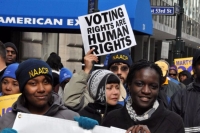
Returning to campus, these students made the choice to leverage the power of their institutions by calling on their colleges and universities to divest from another apartheid, one less defined by a legal regime of segregation than a legacy of poisoned air, extracted labor and stolen land. Since then, fossil fuel divestment has spread like wildfire to over 500 campuses worldwide, changing the narrative around where responsibility for the climate crisis really lies. By naming fossil fuel corporations as the main barrier to climate justice, this student-led divestment movement has already begun to shift popular opinion and put oil, coal and natural gas executives on the defensive.
We know that the climate crisis is not some far-off apocalypse, but a current ongoing fight for survival in communities here in the United States and around the world. It is a crisis whose symptoms are ecological, but whose root causes lie in an economy structurally ill-equipped to respect land, labor and human dignity. We know that now is the time for all of us to make a choice - between a dirty industry and a just future; between young people and the billionaire CEOs dismantling their futures and so many others’ present lives. This semester, by committing to escalate their campus campaigns through nonviolent direct action, students are acting on the knowledge that another world is not only possible, but necessary and within reach. Those on the frontlines of extraction and climate change have understood this for generations; weathering the crisis, for all of us, will take learning from these experiences, and catalyzing a movement more creative and collaborative than any yet. In this, climate change presents both a challenge and an incredible opportunity to re-define the terms of debate.
In the early 20th century, the Coal Wars--between union miners and coal company bosses--birthed a song and a message, emergent from the same mountains and deep lineage of struggle that inspired the first campaign for fossil fuel divestment: "Which Side Are You On?" Today, as a new generation joins the fight against the fossil fuel industry, those words mean more than they ever have. In failing to divest, college and universities stand on the wrong side of history. By taking strategic action this spring, students are posing a similarly crucial question to the public and their institutions’ leadership: whose side are you on?
Despite the guise of climate denial, the industry executives' side understands that the tides are rising—but believes that money can serve as a life raft. Through austerity measures, wars for oil and a prevailing narrative of scarcity, they are already working towards a future where fewer people control more money. Operating on the assumption that some lives matter more than others, their side—over the last forty years—has pursued reckless economic policies that have led us headfirst into crisis, with those already impacted hit hardest.
Our side knows that, in the words of Crystal Lameman of the Beaver Lake Cree Nation, "We can not eat money and we can not drink oil." Our side sees a future built on not only surviving, but thriving. Our side fights for a future where amenities such as food, water, shelter, education, clean air and healthcare are considered basic rights, not luxury commodities. It is a future where work is valued regardless of its ability to generate profit for the 1 percent, and that recognizes the abundance of the earth and the people living on it. It is a future where Black lives matter, where First Nations’ treaty rights are honored, and where a person’s citizenship status does not determine their character. It is a future where workers have family-sustaining jobs building the vital infrastructure that will carry us through a just transition away from fossil fuel dependency.
America’s colleges and universities stand at a crossroads. We sign in solidarity not only with students’ fight for fossil fuel divestment in higher education, but with a vision for the future. This vision cannot be built solely in the halls of elite institutions, but must be constructed collaboratively among young people, frontlines leaders, working people and movement elders, drawing from the wisdom and resilience of those who know the reality of crisis all too well. Investing in fossil fuels is a breach of both fiduciary responsibility and trust in America’s next generation of leaders. If you are an alumni, faculty member, or another student, we stand with you, and we hope you will join us in this critical fight for a just future.
Signed,
Andrea Gibson, Renowned Slam Poet & Activist
Bill McKibben, 350.org
Colette Pichon Battle, Gulf Coast Center for Law & Policy
Ed Whitfield, Fund for Democratic Communities
Elandria Williams, Highlander Research and Education Center
Gopal Dayaneni, Movement Generation
George Lakey, Earth Quaker Action Team
KC Golden, Senior Policy Advisor, Climate Solutions & Board Chair, 350.org
Melina Laboucan-Massimo, Lubicon Cree First Nation, Climate Campaigner with Greenpeace Canada
Marnie Thompson, Fund for Democratic Communities
Regenerative Finance
United We Dream
Link to original article from Common Dreams
 Imagine going to the polls on Election Day and discovering that your ballot could be collected and reviewed by the
 ACLU Blueprints Offer Vision to Cut US Incarceration Rate in Half by Prioritizing 'People Over Prisons'
  "These disasters drag into the light exactly who is already being thrown away," notes Naomi Klein
  How about some good news? Kansas Democratic Representative advances bill for Native Peoples.
  What mattered was that he showed up — that he put himself in front of the people whose opinions on
 On a night of Democratic victories, one of the most significant wins came in Virginia, where the party held onto
 A seismic political battle that could send shockwaves all the way to the White House was launched last week in
 In an interview with Reuters conducted a month after he took office, Donald Trump asserted that the U.S. had “fallen
 Attorney General Jeff Sessions overturned the sweeping criminal charging policy of former attorney general Eric H. Holder Jr. and directed