


The Southern Education Foundation reports that 51 percent of students in pre-kindergarten through 12th grade in the 2012-2013 school year were eligible for the federal program that provides free and reduced-price lunches. The lunch program is a rough proxy for poverty, but the explosion in the number of needy children in the nation’s public classrooms is a recent phenomenon that has been gaining attention among educators, public officials and researchers.
“We’ve all known this was the trend, that we would get to a majority, but it’s here sooner rather than later,” said Michael A. Rebell of the Campaign for Educational Equity at Teachers College at Columbia University, noting that the poverty rate has been increasing even as the economy has improved. “A lot of people at the top are doing much better, but the people at the bottom are not doing better at all. Those are the people who have the most children and send their children to public school.”
The shift to a majority-poor student population means that in public schools, a growing number of children start kindergarten already trailing their more privileged peers and rarely, if ever, catch up. They are less likely to have support at home, are less frequently exposed to enriching activities outside of school, and are more likely to drop out and never attend college.
It also means that education policy, funding decisions and classroom instruction must adapt to the needy children who arrive at school each day. 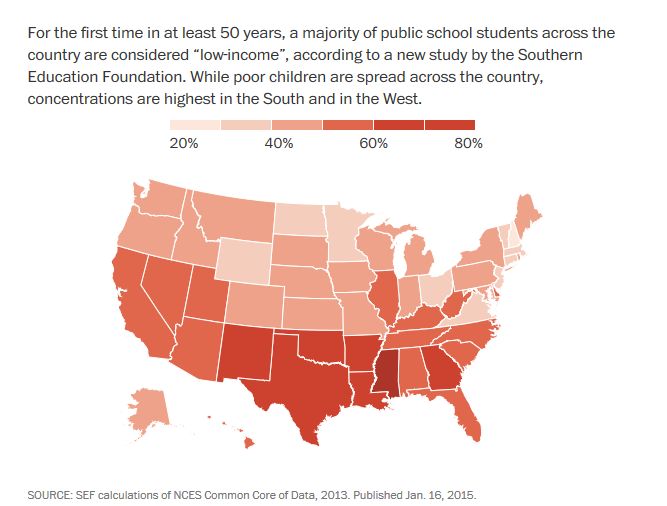
“When they first come in my door in the morning, the first thing I do is an inventory of immediate needs: Did you eat? Are you clean? A big part of my job is making them feel safe,” said Sonya Romero-Smith, a veteran teacher at Lew Wallace Elementary School in Albuquerque. Fourteen of her 18 kindergartners are eligible for free lunches.
She helps them clean up with bathroom wipes and toothbrushes, and she stocks a drawer with clean socks, underwear, pants and shoes.
Romero-Smith, 40, who has been a teacher for 19 years, became a foster mother in November to two girls, sisters who attend her school. They had been homeless, their father living on the streets and their mother in jail, she said. When she brought the girls home, she was shocked by the disarray of their young lives.
“Getting rid of bedbugs, that took us a while. Night terrors, that took a little while. Hoarding food, flushing a toilet and washing hands, it took us a little while,” she said. “You spend some time with little ones like this and it’s gut wrenching. . . . These kids aren’t thinking, ‘Am I going to take a test today?’ They’re thinking, ‘Am I going to be okay?’ ”
The job of teacher has expanded to “counselor, therapist, doctor, parent, attorney,” she said.
Schools, already under intense pressure to deliver better test results and meet more rigorous standards, face the doubly difficult task of trying to raise the achievement of poor children so that they approach the same level as their more affluent peers.
“This is a watershed moment when you look at that map,” said Kent McGuire, president of the Southern Education Foundation, the nation’s oldest education philanthropy, referring to a large swath of the country filled with high-poverty schools.
“The fact is, we’ve had growing inequality in the country for many years,” he said. “It didn’t happen overnight, but it’s steadily been happening. Government used to be a source of leadership and innovation around issues of economic prosperity and upward mobility. Now we’re a country disinclined to invest in our young people.”
The data show poor students spread across the country, but the highest rates are concentrated in Southern and Western states. In 21 states, at least half the public school children were eligible for free and reduced-price lunches — ranging from Mississippi, where more than 70 percent of students were from low-income families, to Illinois, where one of every two students was low-income.
Carey Wright, Mississippi’s state superintendent of education, said quality preschool is the key to helping poor children.
“That’s huge,” she said. “These children can learn at the highest levels, but you have to provide for them. You can’t assume they have books at home, or they visit the library or go on vacations. You have to think about what you’re doing across the state and ensuring they’re getting what other children get.”
Darren Walker, president of the Ford Foundation, was born in a charity hospital in 1959 to a single mother. Federal programs helped shrink the obstacles he faced, first by providing him with Head Start, the early-childhood education program, and later, Pell grants to help pay tuition at the University of Texas, he said.
The country needs to make that same commitment today to help poor children, he said.
“Even at 8 or 9 years old, I knew that America wanted me to succeed,” he said. “What we know is that the mobility escalator has simply stopped for some Americans. I was able to ride that mobility escalator in part because there were so many people, and parts of our society, cheering me on.”
“We need to fix the escalator,” he said. “We fix it by recommitting ourselves to the idea of public education. We have the capacity. The question is, do we have the will?”
The new report raises questions among educators and officials about whether states and the federal government are devoting enough money — and using it effectively — to meet the complex needs of poor children.
The Obama administration wants Congress to add $1 billion to the $14.4 billion it spends annually to help states educate poor children. It also wants Congress to fund preschool for those from low-income families. Collectively, the states and the federal government spend about $500 billion annually on primary and secondary schools, about $79 billion of it from Washington.
The amount spent on each student can vary wildly from state to state. States with high student-poverty rates tend to spend less per student: Of the 27 states with the highest percentages of student poverty, all but five spent less than the national average of $10,938 per student.
Republicans in Congress have been wary of new spending programs, arguing that more money is not necessarily the answer and that federal dollars could be more effective if redundant programs were streamlined and more power was given to states.
Many Republicans also think that the government ought to give tax dollars to low-income families to use as vouchers for private-school tuition, believing that is a better alternative to public schools.
GOP leaders in Congress have rebuffed President Obama’s calls to fund preschool for low-income families, although a number of Republican and Democratic governors have initiated state programs in the past several years.
The report comes as Congress begins debate about rewriting the country’s main federal education law, first passed as part of President Lyndon B. Johnson’s “War on Poverty” and designed to help states educate poor children. The most recent version of the law, known as No Child Left Behind, has emphasized accountability and outcomes, measuring whether schools met benchmarks and sanctioning them when they fell short.
That federal focus on results, as opposed to need, is wrongheaded, Rebell said.
“We have to think about how to give these kids a meaningful education,” he said. “We have to give them quality teachers, small class sizes, up-to-date equipment. But in addition, if we’re serious, we have to do things that overcome the damages of poverty. We have to meet their health needs, their mental health needs, after-school programs, summer programs, parent engagement, early-childhood services. These are the so-called wraparound services. Some people think of them as add-ons. They’re not. They’re imperative.”
Link to original article from The Washington Post
 Imagine going to the polls on Election Day and discovering that your ballot could be collected and reviewed by the
 ACLU Blueprints Offer Vision to Cut US Incarceration Rate in Half by Prioritizing 'People Over Prisons'
  "These disasters drag into the light exactly who is already being thrown away," notes Naomi Klein
  How about some good news? Kansas Democratic Representative advances bill for Native Peoples.
  What mattered was that he showed up — that he put himself in front of the people whose opinions on
 On a night of Democratic victories, one of the most significant wins came in Virginia, where the party held onto
 A seismic political battle that could send shockwaves all the way to the White House was launched last week in
 In an interview with Reuters conducted a month after he took office, Donald Trump asserted that the U.S. had “fallen
 Attorney General Jeff Sessions overturned the sweeping criminal charging policy of former attorney general Eric H. Holder Jr. and directed