Board of Directors

Steve Shaff

Stephen Shaff is a community and political organizer, social entrepreneur, and the founder of Community-Vision Partners (C-VP), a community and social solutions Benefit LLC whose mission is to initiate, facilitate and agitate for the Common Good. A significant project of C-VP has been the establishment and development of the Chesapeake Sustainable Business Council (CSBC), a business-led educational and advocacy organization whose mission is to promote and expand sustainable business viability, awareness, and impact within the Chesapeake region (MD, DC and VA). Shaff’s background represents an unusually broad but interrelated series of accomplishments along with a multi-sector network of relationships and contacts. His areas of expertise include inner-city Washington, DC Affordable Housing & Real Estate Development; Community Development and Activism; Green & New Economy Advocacy; Civic & Political Advocacy Leadership and other national movement initiatives.

Steve Shaff

Secretary - People Demanding Action
Executive Director Community Vision Partners
Maryland

Executive Director

Alex Lawson is the executive director of Social Security Works, the convening member of the Strengthen Social Security Coalition— a coalition made up of over 300 national and state organizations representing over 50 million Americans. Lawson was the first employee of Social Security Works, when he served as the communications director, and has built the organization alongside the founding co-directors into a recognized leader on social insurance. Mr. Lawson is a member of the National Academy of Social Insurance. Mr. Lawson is also the co-owner of We Act Radio an AM radio station and media production company whose studio is located in the historic Anacostia neighborhood of Washington, DC. We Act Radio is a mission driven business that is dedicated to raising up the stories and voices of those historically excluded from the media. We Act Radio is also an innovator in the use of online and social media as well as video livestreaming to cover breaking news and events. Most recently, producing video livestreaming from Ferguson, MO as the #FergusonLive project sponsored by Color of Change.

Alex Lawson

Treasurer - People Demanding Action
Social Security Works
Washington, DC

Rev. Rodney Sadler

Dr. Sadler's work in the community includes terms as a board member of the N.C. Council of Churches, Siegel Avenue Partners, and Mecklenburg Ministries, and currently he serves on the boards of Union Presbyterian Seminary, Loaves and Fishes, the Hispanic Summer Program, and the Charlotte Chapter of the NAACP. His activism includes work with the Community for Creative Non-Violence in D.C., Durham C.A.N., H.E.L.P. Charlotte, and he has worked organizing clergy with and developing theological resources for the Forward Together/Moral Monday Movement in North Carolina. Rev. Sadler is the managing editor of the African American Devotional Bible, associate editor of the Africana Bible, and the author of Can a Cushite Change His Skin? An Examination of Race, Ethnicity, and Othering in the Hebrew Bible. He has published articles in Interpretation, Ex Audito, Christian Century, the Criswell Theological Review, and the Journal of the Society of Biblical Literature and has essays and entries in True to Our Native Land, the New Interpreter's Dictionary of the Bible, the Westminster Dictionary of Church History, Light against Darkness, and several other publications. Among his research interests are the intersection of race and Scripture, the impact of our images of Jesus for the perpetuation of racial thought in America, the development of African American biblical interpretation in slave narratives, the enactment of justice in society based on biblical imperatives, and the intersection of religion and politics.

Rev. Rodney Sadler

Co - Chair - People Demanding Action
North Carolina Forward Together/Moral Monday Movem
Radio Host: Politics of Faith - Wednesday @ 11 am

Executive Director and Executive Producer PDA Radio

Andrea Miller is the Executive Director of People Demanding Action, a multi-issue advocacy group. Andrea is both an organizer as well as a digital advocacy expert. She has appeared on the Thom Hartmann show, hosts the Progressive Round Table and is Executive Producer or PDAction Radio. As an IT professional she is also responsible for PDAction's digital strategy and customizes advocacy tools for small to medium size organizations through the Progressive Support Project. She is the former Co-Executive Director of Progressive Democrats of America, was the Democratic Nominee in 2008 for House of Representatives in the Virginia 4th District. Running on a Medicare for All and clean energy platform, Andrea was endorsed by PDA, California Nurses and The Sierra Club. Prior to running for office, Andrea was a part of Congressman Dennis Kucinich’s presidential campaign, first as Statewide Coordinator for Virginia and subsequently as Regional Coordinator. From 2006 until leading the VA Kucinich camppaign Andrea was MoveOn.org’s Regional Coordinator for Central, Southwest and Hampton Roads areas of Virginia and West Virginia.

Andrea Miller

Board Member and Executive Director
Spotsylvania, VA

President and Executive Director

Since September 2013, Dr. Gabriela D. Lemus has served as the President of Progressive Congress. Dr. Lemus served as Senior Advisor to Secretary of Labor Hilda L. Solis and was Director of the Office of Public Engagement from July 2009 until August 2013. Prior to her appointment, she was the first woman to hold the position of Executive Director at the Labor Council for Latin American Advancement (LCLAA) from 2007-2009, and the first woman to chair the National Hispanic Leadership Agenda (NHLA) from 2008-2009. During her tenure at LCLAA, she helped co-found the National Latino Coalition on Climate Change (NLCCC) and was a Commissioner for the Commission to Engage African-Americans on Climate Change (CEAAC). She served 3-year terms on the advisory boards of both the Washington Office on Latin America (WOLA) from 2005-2008 and the United States Labor Education in the Americas Project (USLEAP) from 2006-2009. In January 2013, she was confirmed by the DC Council to sit on the Board of Trustees of the University of the District of Columbia. From 2000-2007, she served as Director of Policy and Legislation at the League of United Latin American Citizens (LULAC) where she launched the LULAC Democracy Initiative - a national Hispanic civic participation campaign and founded Latinos for a Secure Retirement - a national campaign to preserve the Social Security safety net. Dr. Lemus was adjunct professor of international relations and border policy at the University of Memphis, San Diego State University, and the University of San Diego; as well as a Guest Scholar at the University of California, San Diego – Center for U.S.-Mexico Studies. Dr. Lemus has appeared in both English and Spanish language media outlets, including CNN, CNN en Español, C-SPAN, MSNBC, NBC's Hardball, Fox's Neil Cavuto, Univision and NBC-Telemundo among others. She received her doctorate in International Relations from the University of Miami in 1998.

Dr. Gabriela D. Lemus

Co - Chair - People Demanding Action
President and Executive Director
Progressive Congress

Team Leader and Climate Action Radio Host

Russell Greene has been focused on the climate crisis since 1988. He leads the Progressive Democrats of America Stop Global Warming and Environmental Issue Organizing Team, is Advisory Board Chair for iMatter, Kids vs. Global Warming, vice-chair legislation for the California Democratic Party Environmental Caucus and has been an executive in the restaurant industry for over 30 years, with a current focus on the impact of sustainability in business.

Russell Greene

President, People Demanding Action

President & CEO

Rev. Lennox Yearwood Jr., President and CEO of the Hip Hop Caucus, is a minister, community activist and one of the most influential people in Hip Hop political life. He works tirelessly to encourage the Hip Hop generation to utilize its political and social voice.

 A national leader and pacemaker within the green movement, Rev Yearwood has been successfully bridging the gap between communities of color and environmental issue advocacy for the past decade. With a diverse set of celebrity allies, Rev Yearwood raises awareness and action in communities that are often overlooked by traditional environmental campaigns. Rev Yearwood’s innovative climate and clean energy work has garnered the Hip Hop Caucus support from several environmental leaders including former Vice President Al Gore’s Climate Reality Project, National Wildlife Federation, Earthjustice, Sierra Club and Bill McKibben’s 350.org. Rolling Stone deemed Rev Yearwood one of our country’s “New Green Heroes” and Huffington Post named him one of the top ten change makers in the green movement. He was also named one of the 100 most powerful African Americans by Ebony Magazine in 2010, and was also named to the Source Magazine’s Power 30, Utne Magazine’s 50 Visionaries changing the world, and the Root 100 Young Achievers and Pacesetters. Rev Yearwood is a national leader in engaging young people in electoral activism. He leads the national Respect My Vote! campaign and coalition (www.respectmyvote.com). In the 2012 Elections, numerous celebrity partners have joined the campaign to reach their fan bases, including Respect My Vote! spokesperson 2 Chainz. The Hip Hop Caucus registered and mobilized tens of thousands of young voters to the polls in 2012. In 2008, the Hip Hop Caucus set a world record of registering the most voters in one day: 32,000 people across 16 U.S. cities. This effort was part of the Hip Hop Caucus’ 2008 “Respect My Vote!” campaign with celebrity spokespeople T.I., Keyshia Cole and many other recording artists, athletes, and entertainers. Rev Yearwood entered the world of Hip Hop Politics when he served as the Political and Grassroots Director of Russell Simmons’ Hip Hop Summit Action Network in 2003 and 2004. In 2004 he also was a key architect and implementer of three other voter turnout operations – P. Diddy’s Citizen Change organization which created the “Vote Or Die!” campaign; Jay Z’s “Voice Your Choice” campaign; and, “Hip Hop Voices”, a project at the AFL-CIO. It was in 2004 that he founded the Hip Hop Caucus to bring the power of the Hip Hop Community to Washington, DC. After Hurricane Katrina in 2005, Rev Yearwood established the award winning Gulf Coast Renewal Campaign where he led a coalition of national and grassroots organizations to advocate for the rights of Katrina survivors. The coalition successfully stopped early rounds of illegal evictions of Katrina survivors from temporary housing, held accountable police and government entities to the injustices committed during the emergency response efforts, supported the United Nations “right to return” policies for internally displaced persons, promoted comprehensive federal recovery legislation, and campaigned against increased violence resulting from lack of schools and jobs in the years after Katrina. Rev Yearwood is a retired U.S. Air Force Reserve Officer. In the lead up to the 2003 invasion of Iraq he began speaking out against such an invasion. He has since remained a vocal activist in opposition to the U.S. wars in Iraq and Afghanistan. In 2007 he organized a national pro-peace tour, “Make Hip Hop Not War”, which engaged urban communities in discussions and rallies about our country’s wars abroad and parallels to the structural and physical violence poor urban communities endure here at home. Rev Yearwood is a proud graduate of Howard University School of Divinity and the University of the District of Columbia (UDC), both Historically Black Colleges and Universities. He served as student body president at both institutions. As a student at UDC, he organized massive student protests and sit-ins, shutting down the school for ten days straight, and achieved victory against budget cutbacks. After graduating from UDC he served as the Director of Student Life at a time when the city was attempting to relocate the school, under his leadership the city was forced to rescind its effort to marginalize and move the campus. Rev Yearwood went on to teach at the Center for Social Justice at Georgetown University, before entering the world of Hip Hop politics with Russell Simmons and civil rights activist, Dr. Benjamin Chavis. He has been featured in such media outlets as CNN, MSNBC, BET, Huffington Post, Newsweek, The Nation, MTV, AllHipHop.com, The Source Magazine, Ebony and Jet, Al Jazeera, BBC, C-Span, and Hardball with Chris Mathews and featured in the Washington Post, The New York Times and VIBE magazine. He was born in Shreveport, Louisiana. The first in his family to be born in the United States, his parents, aunts, and uncles, are from Trinidad and Tobago. Rev Yearwood currently lives in Washington, DC with his two sons, who are his biggest inspiration to making this world a better place.

Rev. Lennox Yearwood

Board Member
President and CEO
Hip Hop Caucus

Board Member

Marc Carr’s passion for social justice and entrepreneurship has led him to work on civil rights campaigns in the Deep South and organize community forums in the U.S. and West Africa. His professional experience includes heading the sales division of a major international corporation in West Africa, consulting for the United Nations Foundation, and working as a Social Media Analyst for McKinsey & Co. Marc is the Founder of Social Solutions, an organization devoted to crowd-sourcing tech solutions to solve intractable social problems. Social Solutions produces a monthly event series, the Capitol Innovation Forum, and the yearly Social Innovation Festival, along with a podcast series, the Capitol Justice Podcast. Social Solutions also spearheads the Capitol Justice Lab, an initiative to reduce the incarceration rate in the nation’s capital by half in five years. Marc is expecting his Master’s Degree in Social Enterprise in 2016 from the American University School of International Service.

Marc Carr

Board Member
Social Solutions
Washington, DC

Board Member

Lise received her Doctorate in Medicine in 1982 from the University of Paris. After interning at hospitals in Paris and Lome, Togo, she completed her residency in psychiatry at St. Elizabeths Hospital in Washington, D.C. Board certified in both general and forensic psychiatry, Lise worked as a staff psychiatrist in public mental health centers in Alexandria and Fairfax, Virginia. For more than twenty years Lise has maintained a private practice in psychiatry. An Assistant Professor of Psychiatry at Georgetown University and an active member of the Medical Society of the District of Columbia, she has worked to educate the public on mental health issues through writing in professional journals, the press and other media outlets. A frequent guest on local and national radio and television, Lise has addressed a range of issues on violence, trauma, and mental illness. Through Physicians for Human Rights, she conducts evaluations of victims of torture seeking asylum in this country and advocates on their behalf. She has served as a consultant to the CIA where she developed psychological assessments of world leaders. In the aftermath of Hurricane Katrina and the earthquake in Haiti Lise provided mental health services to those traumatized by the events. In 2005, concerned about the direction the country was taking -- and believing that a background in science and human behavior would strengthen the political process -- she ran for the U.S. Senate seat in Maryland. In September, 2006, she was chosen as one of the first fifty persons to be trained in Nashville by Al Gore to educate the public about global warming. Lise is an expert on climate change and public health, with a particular interest in the psychological impacts of climate change. She frequently writes and speaks about these issues. In collaboration with the National Wildlife Federation and with funding from the Robert Wood Johnson Foundation she organized a conference held in March 2009 on the mental health and psychological impacts of climate change. Lise is on the board of The Center for Health and the Global Environment at Harvard School of Public Health, the Chesapeake Climate Action Network, and the International Transformational Resilience Coalition.

Dr. Lise Van Susteren

Board Member
Moral Action on Climate
Maryland
Monday, 03 November 2014 00:00

For Moment, the World Embraces the Cuba Model – and Slaps the Empire

Written by Glen Ford | Common Dreams
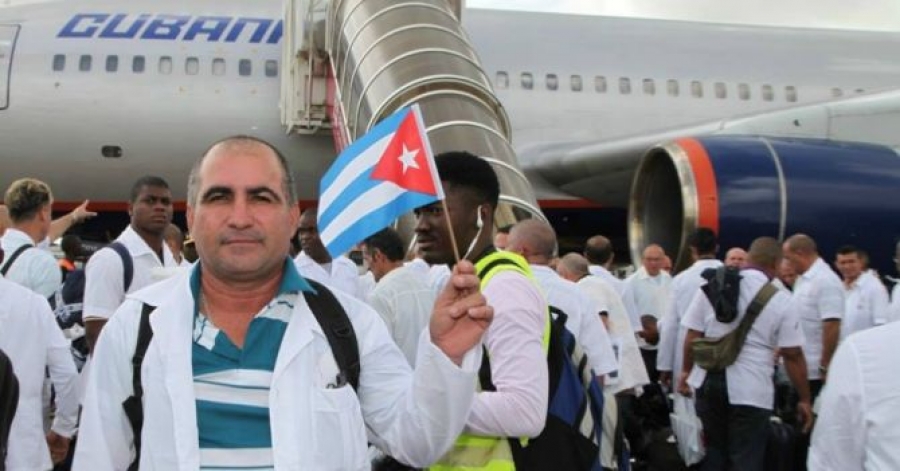
A team of 165 Cuban medical doctors and nurses have arrived in Sierra Leone to support the Ebola response efforts. A team of 165 Cuban medical doctors and nurses have arrived in Sierra Leone to support the Ebola response efforts. (Photo: WHO/S. Gborie)

“For Cuba, service to oppressed and exploited peoples is a revolutionary act of the highest moral caliber.”

Revolutionary Cuba has always been a miracle and gift to all humankind. This week, the nations of the world – with two savage exceptions – instructed their emissaries at the UN General Assembly to tell the world’s self-designated “indispensable” country to end its 54-year-long trade embargo against Cuba. The virtually unanimous global rebuke to the American superpower, in combination with the extraordinary breadth and depth of acclamation accorded Havana, tells us that it is Cuba, not the U.S., that is the truly “exceptional” nation on the planet.

It was the 23rd time that the United Nations has rejected the embargo. The outcome was identical to last year’s tally, with only the United States and Israel voting against the non-binding resolution. Although the list of American allies on the Cuban embargo issue could not possibly get any smaller – Israel, after all, can only exist if joined at the U.S. hip – this year’s political environment was even less deferential to the reigning military colossus. In recognition of its singular commitment to the fight against Ebola in Africa, Cuba soared, once again – the hero nation.

Despite having suffered cumulative economic damages of more than $1 trillion at U.S. hands over the last half-century, the island nation of 11 million people has made itself a medical superpower that shares its life-saving resources with the world. No country or combination of nations and NGOs comes close to the speed, size and quality of Cuba’s response to the Ebola crisis in West Africa. With 461 doctors, nurses and other health professionals either already on site or soon to be sent to Liberia, Sierra Leone and Guinea, Cuba sets the standard for international first-response. The Cuban contingent of medical professionals providing direct treatment to sick people outnumbers that of the African Union and all individual countries and private organizations, including the Red Cross. (Few of the 4,000 U.S. military personnel to be deployed in the region will ever lay a well-protected hand on an Ebola patient. Instead, the troops build field hospitals for others to staff.)

Doctors Without Borders is second to Cuba in terms of health professionals. But the French NGO is a swiftly revolving door, churning doctors and nurses in and out every six weeks because of the extreme work and safety conditions. Cuba’s health brigades are made of different stuff. Every volunteer is expected to remain on duty in the Ebola zone for six months. Moreover, if any of the Cubans contract Ebola or any other disease, they will be treated at the hospitals where they work, alongside their African patients, rather than sent home. (One Cuban died of cerebral malaria, in Guinea, last Sunday.)

It goes without saying that the Cubans are committed for the duration of the Ebola crisis; they have been at Africa’s service since the first years of the revolution. President Raul Castro reports that 76,000 Cuban medical specialists have served in 39 African countries over the years. Four thousand were stationed in 32 African countries when the current Ebola epidemic broke out. (Worldwide, Cuba’s “white-robed army” of care-givers numbers more than 50,000, in 66 countries – amid constant U.S. pressures on host countries to expel them.)

In sheer numbers, the Cuban medical posture in Africa is surpassed in scope only by the armed presence of AFRICOM, the U.S. military command, which has relationships with every country on the continent except Eritrea, Zimbabwe and Sudan. The governments of Liberia, Guinea and Sierra Leone collaborate militarily with AFRICOM, but the heavily-armed Americans were of no use when Ebola hit. (According to a Liberian newspaper account, the Americans caused the epidemic, a widely held belief in the region.)

Indeed, the Euro-American legacy in Africa, from colonialism (Liberia has been a de facto colony of the U.S. since the days of President Monroe) to western-imposed financial “structural adjustments” that starved public health systems, is the root reason Liberia and Guinea have only one doctor for every 100,000 people, and Sierra Leone has just two.

Cuba knows colonialism well, having seen its independence struggle from Spain aborted by the United States in 1898, followed by six decades as a U.S. semi-colony. For Cuba, service to oppressed and exploited peoples is a revolutionary act of the highest moral caliber. That’s why, when the call went out, 15,000 Cubans competed for the honor to battle Ebola in Africa. As reported in The Guardian, doctors like Leonardo Fernandez were eager to fulfill their moral and professional mission. “We know that we are fighting against something that we don’t totally understand,” he said. “We know what can happen. We know we’re going to a hostile environment. But it is our duty. That’s how we’ve been educated.”

In the same way and for the same reasons, 425,000 Cubans volunteered for military service in Angola, from 1975 to 1991, leaving only after Angola was secure, Namibia had held its first free elections and South Africa was firmly on the road to majority rule. These Cubans were preceded by the doctor and soldier Che Guevara and 100 other fighters who journeyed to Congo in 1965 to join an unsuccessful guerilla war against the American-backed Mobutu regime.

Cuba has been selfless in defense of others, whether against marauding microbes or imperial aggression. “We never took any natural resources,” said Rodolfo Reyes Rodriguez, Cuba’s ambassador to the United Nations and a veteran of the war against white-ruled South Africa’s army in Angola. “We never took any salary, because in no way were we to be perceived to be mercenaries or on any kind of military adventure.”

For the United States, military adventure and the imperative to seize other countries’ natural resources or strangle their economies, are defining national characteristics – in complete contrast to Cuba. The U.S. embargo of its island neighbor is among the world’s longest-running morality plays, with Washington as villain. On this issue, the world’s biggest economic and military power could neither buy nor bully a single ally other than the Zionist state deformity.

Even Djibouti, the wedge of a nation between Eritrea and Somalia that hosts the biggest U.S. (and French) military base in Africa, spoke against the embargo on behalf of the Organization of Islamic Cooperation. Lithuania, a rabidly anti-Russian Baltic state, voiced the European Union’s objections to the embargo. Ethiopia, Washington’s henchman in the Horn of Africa, nevertheless opposed U.S. policy toward Cuba on behalf of the UN’s “Africa Group.” Tiny Fiji articulated the Group of 77 and China’s opposition to the trade blockade. Venezuela, Cuba’s major health partner in Latin America, voiced the anti-embargo position of Mercosur, the Common Market of the South.

Cuba’s neighbors in CARICOM, the Caribbean Economic Community, were represented by Saint Kitts and Nevis, whose ambassador pointed to Cuban-built hospitals and clinics throughout the region; the hundreds of Cuban doctors that have provided the only medical services available to many of Haiti’s poor before, during and after the catastrophic earthquake of 2010; and the thousands of Caribbean students that have benefited from free university education in Cuba.

Cuba’s exemplary conduct in the world has made the yearly UN vote on the U.S. embargo a singular opportunity for all the world body’s members, except one, to chastise the superpower that seeks full spectrum domination of the planet. It is the rarest of occasions, a time of virtual global unanimity on an evil in which the Empire is currently engaged. Once a year, the world – in both effect and intent – salutes the Cuban model. For a moment, humanity’s potential to organize itself for the common good illuminates the global forum.

This year, the model glows brightly in the darkness of microbial pestilence. When 15,000 Cuban health care workers do not hesitate to step into the Ebola pit, the New Man and Woman may already exist – and there is hope for the rest of us.

Link to original article from Common Dreams
Read 32266 times

Latest News

  • Trump administration's voter suppression attempts ahead of midterms are not only 'morally wrong,' they're illegal +

    Trump administration's voter suppression attempts ahead of midterms are not only 'morally wrong,' they're illegal Imagine going to the polls on Election Day and discovering that your ballot could be collected and reviewed by the Read More
  • ACLU Blueprints Offer Vision to Cut US Incarceration Rate in Half by Prioritizing 'People Over Prisons' +

    ACLU Blueprints Offer Vision to Cut US Incarceration Rate in Half by Prioritizing 'People Over Prisons' ACLU Blueprints Offer Vision to Cut US Incarceration Rate in Half by Prioritizing 'People Over Prisons' Read More
  • As Florence Makes Landfall, Poorest Once More Likely to Suffer Most From Storm's Destruction +

    As Florence Makes Landfall, Poorest Once More Likely to Suffer Most From Storm's Destruction "These disasters drag into the light exactly who is already being thrown away," notes Naomi Klein Read More
  • How about some good news? Kansas Democratic Representative advances bill for Native Peoples. +

    How about some good news? Kansas Democratic Representative advances bill for Native Peoples. How about some good news? Kansas Democratic Representative advances bill for Native Peoples. Read More
  • How One Dying Man Changed The Debate About The Tax Bill +

    How One Dying Man Changed The Debate About The Tax Bill What mattered was that he showed up — that he put himself in front of the people whose opinions on Read More
  • Democrats Just Won a Major Victory in Virginia +

    Democrats Just Won a Major Victory in Virginia On a night of Democratic victories, one of the most significant wins came in Virginia, where the party held onto Read More
  • Repealing the Jim Crow law that keeps 1.5 million Floridians from voting. +

    Repealing the Jim Crow law that keeps 1.5 million Floridians from voting. A seismic political battle that could send shockwaves all the way to the White House was launched last week in Read More
  • Nuclear Weapons: Who Pays, Who Profits? +

    Nuclear Weapons: Who Pays, Who Profits? In an interview with Reuters conducted a month after he took office, Donald Trump asserted that the U.S. had “fallen Read More
  • Sessions issues sweeping new criminal charging policy +

    Sessions issues sweeping new criminal charging policy Attorney General Jeff Sessions overturned the sweeping criminal charging policy of former attorney general Eric H. Holder Jr. and directed Read More
  • 1
  • 2